

The awe of stars
To give you access to my very creative, sometimes obsessively thinking brain I’ll share some mental drops today. No matter from which angle we look at them sparkly things, they continue to be astonishing.
Here is a collection of what, in my opinion, makes stars magnificient - and worth adding to the list of awe inspiring things.
Of course, my collection offers only a tiny glimpse into the immense field of astronomy. Nevertheless, I hope it inspires you and gives a little taste of the starry sky.
Scientifically
Starlight is a Time Machine: The light from stars takes years, centuries, or millennia to reach us. When you look at the stars, you see them not as they are, but as they were. The light from the nearest star (Proxima Centauri) is over 4 years old; the light from Betelgeuse in Orion is about 640 years old.
Yet, you can see stars as they were 4,000 years ago with the naked eye. Without a telescope, all the stars we can see lie within about 4,000 light-years of us. That means at most you’re seeing stars as they were 4,000 years ago, around when the pyramids were being built in Egypt. Yet because of the light traveling slower through the universe, most of the stars we see are not existing anymore. You are literally looking into the past.
Some awesome facts:
• There are more stars in the universe than grains of sand on all Earth’s beaches.
• When giant stars run out of fuel, they explode as supernovae, briefly outshining entire galaxies and scattering iron and carbon into space to help form new stars, planets, and life.
Romantically
We Are Starstuff. The iron in your blood, the calcium in your bones, and the oxygen you breathe were forged in the hearts of massive stars. These elements were scattered across the cosmos in stellar explosions (supernovae) billions of years ago, eventually coalescing into our planet and us. We are the universe, conscious of itself.
And like stars, exploding in their moment of death, birthing new galaxies, we are constantly birthing new stars in the form of ideas, thoughts, impulses, emotions, fired up nerves etc. inside of us.
As a little mental journey: How would you move if your body was filled with living spiderwebs, of magic and rivers of liquid starlight, shining through all the dark nights of your soul?
Poetically
Star constellations are Human Stories. The patterns we see are not physical groupings, but a celestial canvas upon which every human culture has projected its myths, heroes, and animals. The same points of light tell the story of Orion the Hunter, the Chinese White Tiger, and the Aboriginal Berriberri (a pack of dingoes). Astrologly and reading the sky for navigation has been part of human history since the beginning.
No wonder many poets and writers have dedicated dedicated their words, and thoughts to the fascinations of starlight, the cosmos and the beauty of not being able to capture the mystery in it’s entirety.

Starting with a quote by Gustave Flaubert, who talks about our inability to put the stars’ magic into words: ”Human speech is like a cracked kettle on which we tap crude rhythms for bears to dance to, while we long to make music that will melt the stars.”

And now some proper poetry:

Dead Stars
Out here, there’s a bowing even the trees are doing.
              Winter’s icy hand at the back of all of us.
Black bark, slick yellow leaves, a kind of stillness that feels
so mute it’s almost in another year.
I am a hearth of spiders these days: a nest of trying.
We point out the stars that make Orion as we take out
      the trash, the rolling containers a song of suburban thunder.
It’s almost romantic as we adjust the waxy blue
      recycling bin until you say, Man, we should really learn
some new constellations.
And it’s true. We keep forgetting about Antlia, Centaurus,
       Draco, Lacerta, Hydra, Lyra, Lynx.
But mostly we’re forgetting we’re dead stars too, my mouth is full
          of dust and I wish to reclaim the rising—
to lean in the spotlight of streetlight with you, toward
    what’s larger within us, toward how we were born.
Look, we are not unspectacular things.
      We’ve come this far, survived this much. What
would happen if we decided to survive more? To love harder?
What if we stood up with our synapses and flesh and said, No.
         No, to the rising tides.
Stood for the many mute mouths of the sea, of the land?
What would happen if we used our bodies to bargain
for the safety of others, for earth,
                if we declared a clean night, if we stopped being terrified,
if we launched our demands into the sky, made ourselves so big
people could point to us with the arrows they make in their minds,
rolling their trash bins out, after all of this is over?

by Ada Limón
The stars,
This mass of shining parts,
Dying is a form of art,
When going back to darkness.
It lights my heart how precious yet aggressively forceful
exploding is.
Going back to the dark sea,
the light will be seeded and formed out of millions of possibilities.
Formed and fostered until it's strong enough to gleam.
A womb for stars
 has to be a black mass of mystery
about the size of a Childs mouth,
eating balls of clay to feed this potent infinity,
of all that you cannot see.
Invisibility.
A whole load of nothingness inside
the sensual lips, to love
everything delicious and rich.

by Luisa Doerstel (Me)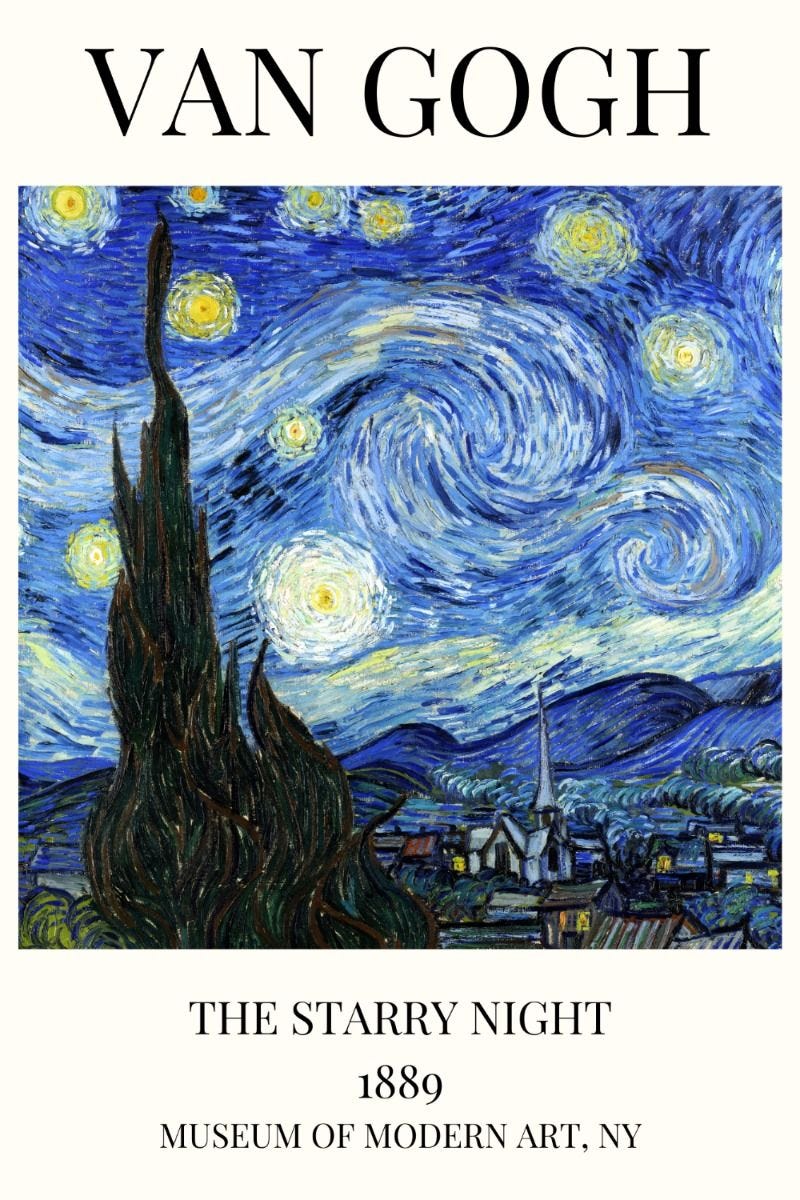
Stars hold rich symbolic significance representing hope in times of darkness, inspiration in moments of doubt, and the eternal cycle of birth, life, and death
Stars represent a sense of wonder and mystery that cannot be captured by facts and figures—a reminder that some things cannot be fully explained by human knowledge alone. Will we ever fully understand the vastness of darkness & light around us?! I doubt it. But there is beauty in keeping some mystery, too.
At least for our human lifestimes I believe mystery is necessary for us to continue exploring.
Someone said “the day we solve the last mystery is the day we die’.
I must say, I really like that thought.
And to conclude this brief excursion into the mysteries of starlight, I would like to quote Ralph Waldo Emerson: “We are all astronomers observing the stars, but few can read the heavens.”